
Multi-site benchmark
Compare your sites’ contracts and find the gaps
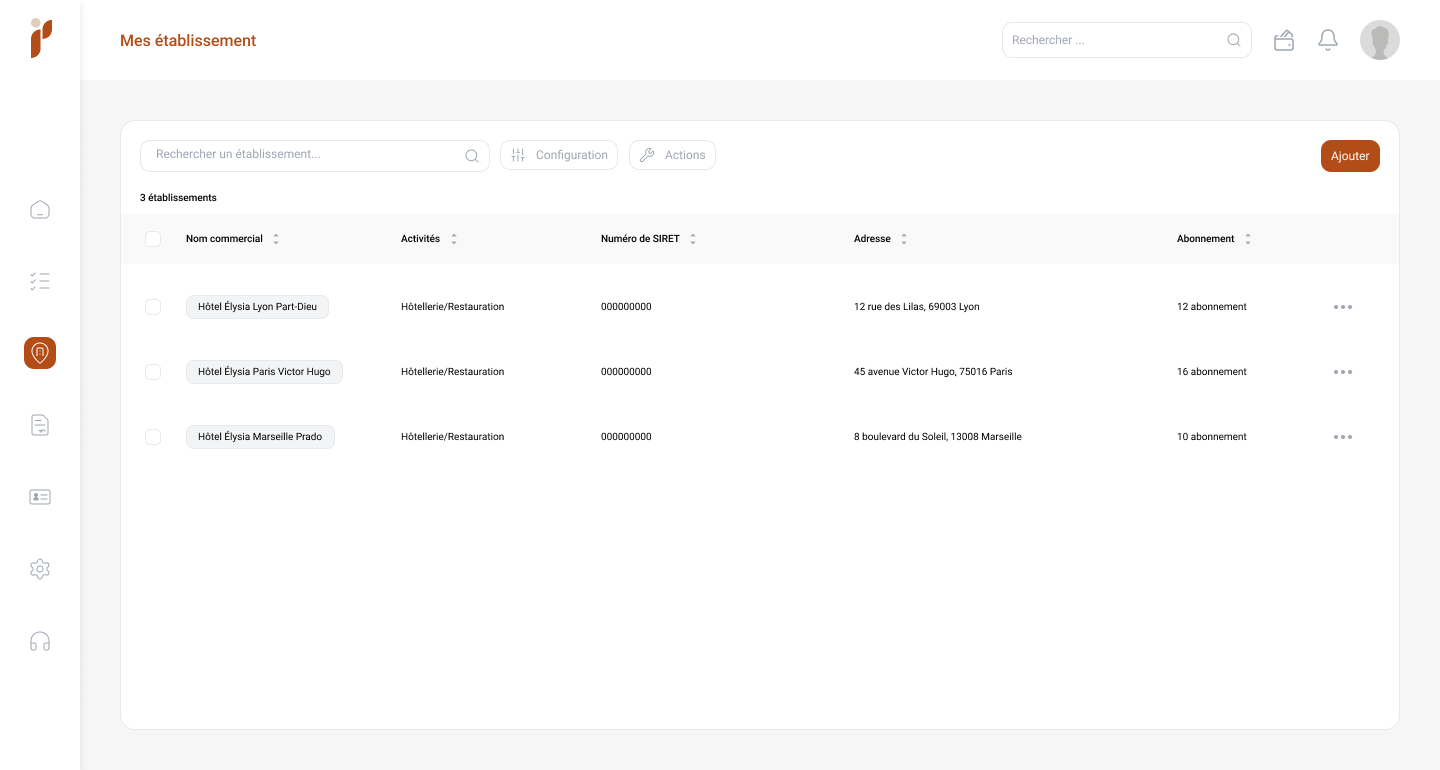
Two hotels in the same group, the same service, two different rates. The gap is almost always there — you just need a tool that shows it.
- Site-by-site comparison
- Consolidated group view
- Price gaps detected
- Contracts to pool
A group that does not compare itself pays twice
Gaps between sites almost never come from bad negotiation. They come from separate negotiations.
Each site signed its contracts at its own pace, with its own contacts and its own history. One negotiated a volume discount, another still pays the entry rate agreed at opening, a third has a framework agreement nobody remembers. As long as those contracts live in separate folders, no comparison happens — and without comparison, no pooling is possible. The group loses twice: the best rate it has already obtained somewhere, and the weight its sites would carry together.
Contracts negotiated separately
Each site deals on its own. The sum of the negotiations is not a group negotiation.
Gaps never measured
You suspect one site pays more. Nobody has the figure.
Data that will not compare
Without common categories, comparing two sites means nothing.
What the benchmark puts on the table
A shared structure, shared categories, and comparison becomes immediate.
-
Line-by-line comparison
The same service, from the same type of supplier, site by site: the comparison table builds itself from one filter.
-
Gap detection
When one site pays noticeably more than another for an equivalent line, the gap surfaces instead of staying buried.
-
The consolidated group view
Total committed per category, across all sites, gives the group’s real weight facing a supplier.
-
Candidates for pooling
Contracts spread across several providers for the same service are the first to bring together.
-
Harmonising the terms
Once the best contract is identified, it becomes the model the other sites move towards at their next renewal.
-
Exports ready to present
Comparisons export for the board, the network head office or a supplier tender.
How you make sites comparable
Comparison is not a module: it is the consequence of a shared naming convention.
-
You attach each contract to its site
A contract belongs to a site, or to the group if it is a framework agreement.
-
You adopt common categories
This is the decisive step: without shared vocabulary between sites, no comparison holds.
-
You fill in the amounts
The current rate and its period are enough. Historical depth comes with time.
-
You read the comparison
By category, supplier or period, gaps between sites appear with no prior processing.
-
You align at each renewal
Every renewal becomes a chance to bring one site closer to the group’s best terms.
What you gain
Gaps put into figures. You stop debating an impression and start debating an amount, site by site.
Real negotiating weight. The supplier sees the group’s volume, not one site in isolation.
Good terms that spread. The best contract obtained somewhere becomes the reference for the others.
A head office with the tools. Central teams finally get a consolidated reading without chasing spreadsheets.
Frequently asked questions
What does it take for two sites to be comparable?
A shared naming convention. As long as each site names and files its contracts its own way, no comparison means anything. So the prerequisite is adopting the same categories, even if you deliberately keep them few.
Do all contracts have to be centralised at head office?
No, and it is often undesirable. Each site keeps control of its contracts; head office gets a consolidated read-only view. It is the shared structure that enables comparison, not centralised management.
How do I identify which contracts to pool first?
Those where several sites buy the same service from different providers, and where the price gap is widest. Those are the quickest and least risky gains.
Is a price gap between two sites always abnormal?
No. Size, location, service level or the length of the relationship justify legitimate differences. The benchmark does not settle the matter: it puts the question in the right place.
How do I handle a framework agreement and its site versions?
The framework is recorded at group level and each version at its own site, with a link between them. Common terms stay visible while local specifics are tracked.
How many sites does it take to be worthwhile?
Two is enough. The gap between two sites is already a negotiating argument; beyond five, pooling usually becomes the most profitable lever in the portfolio.
Explore further
Compare, harmonise, pool: all three stages are prepared by method.
Measure the gap between your sites
Give us one spend line and two sites: we will show you the comparison Pilboard would produce.